


Long-Term Return Portfolio
Overview
To outperform inflation.
Actively managed with a long-term bias to real assets e.g. equities. The Portfolio normally invests in a wide range of ETFs to gain significant diversification and exceptional liquidity at very low cost.
| Stock Short Name | Percentage of Portfolio |
|---|---|
| iShares Core MSCI EM IMI UCITS ETF | 12.2 |
| Amundi UK Equity All Cap UCITS ETF | 10.8 |
| iShares Core FTSE 100 UCITS ETF | 9.5 |
| VANGUARD INV SER-UK GILT UCITS ETF | 8.1 |
| Invesco FTSE RAFI US 1000 UCITS ETF | 8.1 |
| iShares Core UK Gilts UCITS ETF | 8 |
| Amundi MSCI Japan UCITS ETF | 5.7 |
| Vanguard FTSE 250 UCITS ETF | 4.5 |
| SPDR Sterling Corporate Bond UCITS ETF | 4.2 |
| ISHARES II PLC-USD FLTG RATE BOND U | 3.8 |
| Number of Holdings | Yield to Maturity | Maturity | Duration | S&P Rating |
|---|---|---|---|---|
| 143 Govt. Bonds 1,636 Corp. Bonds | 5.07% | 9.44 | 6.07 | A/A- |
| Number of Holdings | Best Dividend Yield Forward 12m | Best Price to Book Forward | Best P/E Ratio | Best LTG EPS |
|---|---|---|---|---|
| 7,710 | 2.9% | 2.1 | 14.3 | 13.2% |
| Long-Term Return | 7.6% |
|---|---|
| Asia Pacific Ex. Japan (MSCI Asia Ex Jap) | 18.30% |
| Em Markets (MSCI EM) | 17.30% |
| Japan (MSCI Japan) | 14.60% |
| US Equities (MSCI USA) | 12.50% |
| Europe Excl UK (MSCI Eur. Ex UK) | 11.10% |
| UK Equities (MSCI UK) | 9.40% |
| UK Index-Linked Gilts (Barclays UK Infl Linked) | 8.70% |
| UK Gilts (Bloomberg UK Govt All>1 Yr) | 7% |
| UK Corp Bonds (iBoxx Large Cap TRI Index) | 5.20% |
Performance is based on the monthly performance of the first client discretionary portfolio after all charges. Individual client portfolios may differ due partly to differences in the timing of initial investment or withdrawals or rebalancing. The SCM/MoneyShe Long-Term Return (£) Benchmark is inflation (the return of the UK RPI All Items Index). Competitor data is based on the performance of the IA Mixed Investment 40-85% Shares Sector and the comparison is offered as a guide only.
| 12m to 31/08/2021 | 12m to 31/08/2022 | 12m to 31/08/2023 | 12m to 31/08/2024 | 12m to 31/08/2025 | 12m to 31/08/2026 |
|---|---|---|---|---|---|
| 20.1% | -6.9% | 3.9% | 12.5% | 8.8% | 15.7% |
Source: SCM Private LLP
Past performance is not a guide to future returns. The value of investments and the income from them can go down as well as up, so investors may not recover the amount of their original investment.
| ALL Fees & Charges | Percentage |
|---|---|
| SCM Discretionary Fund Management Charge | 0.40% |
| Underlying ETF costs (KIID Ongoing Charge) | 0.16% |
| Transaction Costs of buying/selling funds | 0.12% |
| Transaction Costs within funds | 0.05% |
| Custody & Administration Fee | 0.12% |
| Total Fees & Charges | 0.85% |
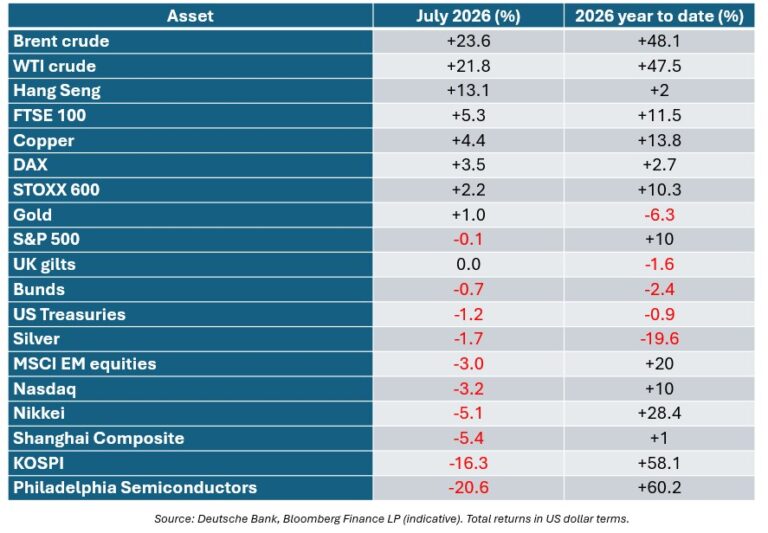
In July, we made no changes to the SCM/MoneyShe Portfolios. On the surface, it was quiet: the S&P 500 slipped 0.1% and world equities were flat. Beneath the surface, July saw the sharpest rotation in decades. The fragile US–Iran peace broke down, as we cautioned last month it might, and Brent crude rose 23.6%, briefly approaching $100 a barrel. And the year’s most crowded trades finally cracked: the Philadelphia semiconductor index fell 20.6%, and Korea’s KOSPI dropped 39% from its June peak. The FTSE 100 was Europe’s best-performing major index.
The quietest crash on record
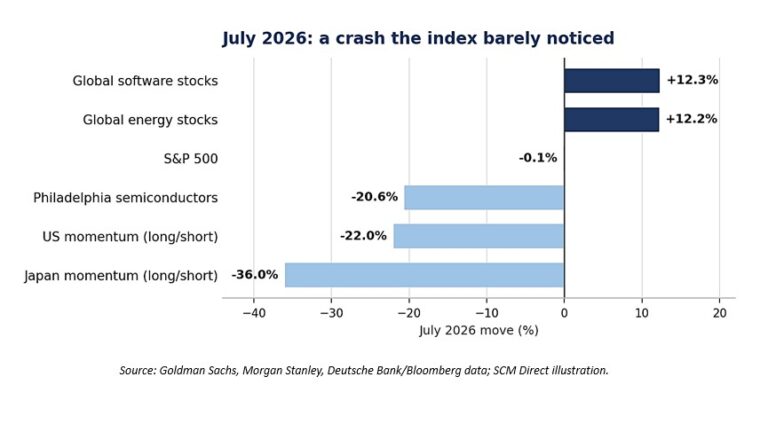
How does a market crash without the index moving? Beneath a flat S&P 500, momentum strategies fell 22% in America and 36% in Japan, technology hedge funds suffered their worst month on record, and SpaceX has shed around $1.2 trillion since its June flotation. Yet the VIX (a measure of volatility) ended July at a sleepy 16: the violence was in individual stocks and strategies, not the index.
What broke was positioning, not profits
Second-quarter earnings beat expectations at record levels, European investment-grade credit spreads ended July exactly where they began, and the equal-weighted S&P 500 overtook the cap-weighted index for the first time since 2009. Panics rarely look like this.
As we wrote in our latest blog, Is Big Really Beautiful?, the ten largest US stocks represent around 40% of the S&P 500, and a standard emerging-markets fund holds almost a third of its money in just three chipmakers. July showed why this matters: those chip stocks sat at the centre of the falls, while our emerging-markets exposure includes nearly 2,000 smaller companies. We prefer to own the haystack rather than the needle.
Paying for credibility
July’s other story was the bond market, where central banks discovered the cost of being doubted. All four major central banks held rates, though three Federal Reserve members dissented for a hike. Markets read Chair Warsh’s press conference as dovish, even as inflation expectations rose. The result was a credibility shock: the dollar fell 1.3%, while the 30-year Treasury yield closed at 5.27%, its highest since 2007.
At home, the Bank of England held rates at 3.75% on a 6 – 3 vote. Gilts rallied on the decision: 10-year yields near 5%, against 2.6% inflation, offer some of the best real returns available, and our move into gilts above 5% continues to reward patience. Brent has since climbed back towards $90, with Hormuz still shut. The inflation genie, as we said last month, is not yet back in the bottle.
SCM/MoneyShe Portfolios
Our refusal to chase the year’s fashionable trades – no momentum, no leverage, no concentrated technology bets, was vindicated in a month when all three cracked; our genuinely diversified holdings did exactly what they are there for. July also strengthened the case for the unfashionable: The valuation gap between US and European equities is now the widest on record, and European economic data is beating expectations by the most in three years.
Alan Miller, Chief Investment Officer
12 August 2026