

Yesterday, the House of Commons Treasury Select Committee published the summary of more than 52,000 public responses to its inquiry into Student Loans and the Taxation of Graduates. The findings are extraordinary. They are also a vindication of the case MoneyShe has been making since March — and the evidence we submitted to the Committee on 13 April.
The Committee has explicitly identified women as a group disproportionately affected by the student loan system. It has set out, in the public’s own words, why the system would be considered unlawful or mis-sold were it an FCA-regulated consumer credit product. And it has confirmed — directly from tens of thousands of graduates — that the everyday damage being done is exactly what our written submission (SLTG0185) and our White Paper, Breaking the Graduate Trap, set out in detail.
What the Treasury Committee found
Drawn from 49,357 respondents who had taken out a student loan:
- 82% said the financial impact was worse than expected when combined with the level of tax.
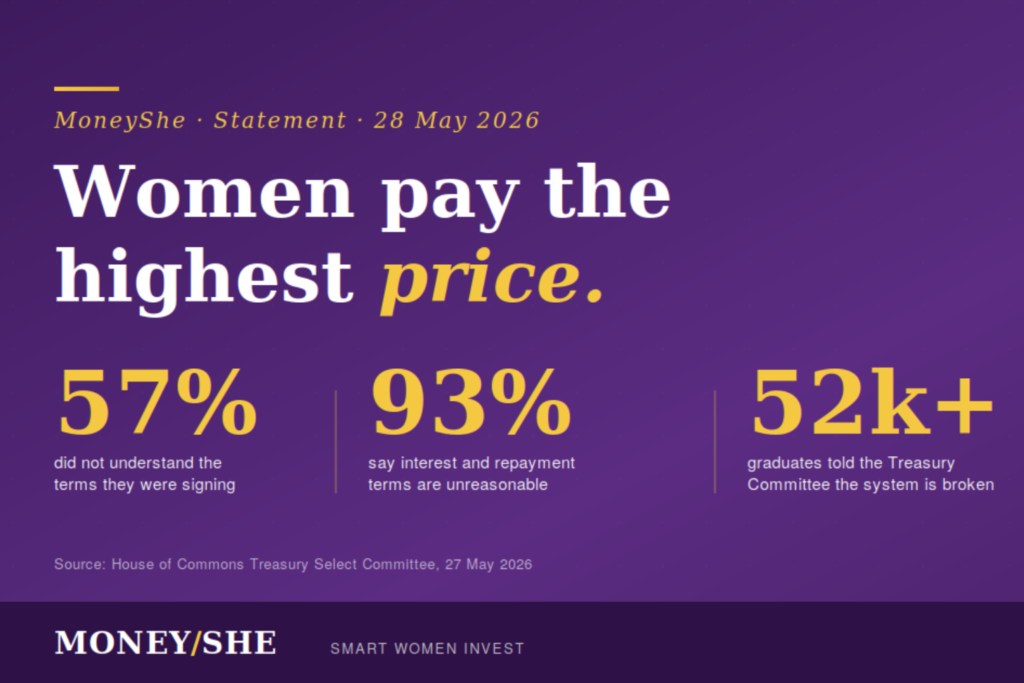
- 93% said the level of interest and repayment terms were unreasonable.
- 57% did not understand the terms and conditions of their loan before taking it out.
- 70% said their loan repayments had a material impact on their financial planning for the future.
- 51% said they would not take out the loan again if given the choice.
- The Committee concluded that student loans are “entrenching class inequality and undermining social mobility.”
The Committee organised the public’s evidence into nine themes. Two stand out for what they confirm.
Theme 7: Women are disproportionately affected
For the first time, a Parliamentary committee has formally identified women as a discrete group disproportionately harmed by the student loan system. The Committee cites three mechanisms named by respondents themselves:
- Interest accruing during maternity leave;
- The permanent worsening of loan balances after career breaks for caring.
- The system’s role in effectively widening the gender pay gap is by punishing mothers who take time out of paid work to raise children.
This is precisely the lifecycle trap MoneyShe set out in our White Paper. Women now make up 57% of university students. They earn less on average, they take career breaks for caring and are more likely to work part-time. The 9% graduate levy bites hardest in their twenties and thirties — the very years when starting a pension makes the greatest long-term difference. Interest continues to grow on their balances while they are on maternity leave. By the time a woman’s student debt is finally written off in her early fifties, the compounding window for retirement savings has been lost.
“The student loan system is not just unfair to today’s young women. It is a pipeline that manufactures pensioner poverty for women thirty years from now.”
Themes 6 and 9: This would be unlawful under FCA rules
Across two separate themes – Mis-selling and Misinformation, and Policy Suggestions – the Committee’s summary reflects a consistent public view that the student loan system would be illegal if applied as an FCA-regulated consumer credit product.
57% of respondents told the Committee they did not understand the terms they were signing. Loans were marketed to under-18s as “like a phone contract,” “the cheapest loan you’ll ever get,” and “not real debt.” Terms have been changed retrospectively in ways that would be unlawful for any commercial lender. Repayment thresholds have been frozen after the contract was struck. Interest mechanics were not explained at the point of sale.
Having spent more than thirty years in regulated financial services, I can say it plainly: no FCA-authorised firm would be permitted to operate on these terms, and no regulator would permit a product sold to young adults with such inadequate disclosure to remain on the market.
What real women told us
Our written submission to the Committee was supported by five first-hand case study testimonies from women living with the consequences:
- A single woman whose loan has grown from £57,000 to £83,000 despite consistent repayment — now considering leaving the country.
- A working couple, both children of immigrant families, paying £5,040 a year in combined repayments and delaying starting a family.
- A 32-year-old earning £65,000 who faces a 51% marginal tax rate wants children but cannot afford the interest that will accrue during maternity leave.
- A single mother whose child will receive £5,000 a year in maintenance loans against £8,000-a-year halls of residence — penalised by the parental assessment system.
- A graduate of 11 years standing whose salary has risen to £68,000 yet only now begins paying off interest, not principal.
These are not outlier cases. They are the everyday reality the Committee has now heard, in their own words, from tens of thousands of others.
What MoneyShe is calling for
The reforms we set out in our written submission to the Committee remain the right basis for action:
- Retrospective interest relief on Plan 2 loans — write down accrued interest to the prevailing Bank of England base rate.
- A meaningful reduction in the 9% repayment rate — to 5% or 6% — to lift the effective marginal tax burden on graduates.
- An end to the threshold freeze, with annual uprating in line with earnings as originally promised.
- Reform of the parental assessment system for maintenance loans, which penalises children of single mothers and blended families.
- A full, public gender impact assessment of the student loan system — long overdue.
- Reform of the pension triple lock as a balanced, intergenerational settlement, with strong protections for the poorest pensioners.
The Committee held the first oral evidence session on 2 June 2026. I have written to the Committee Clerk to offer to give oral evidence at a subsequent session. The announced witness list does not include a contributor focused specifically on either the gendered impact or the FCA consumer credit perspective. That is a gap the Committee should fill.
Dame Meg Hillier has rightly said this inquiry is about fairness. There can be no fair settlement on student finance that does not also reckon with the fact that women pay the highest price.
Gina Miller – MoneyShe Founder and Campaigner
Read the full evidence
- MoneyShe written evidence to the Treasury Select Committee (SLTG0185) — 13 April 2026 (PDF)
- White Paper: Breaking the Graduate Trap — A Fairer Deal Between Students, Workers and Pensioners — March 2026
- Treasury Committee — Summary of public survey responses — 27 May 2026 (PDF)
- This statement as a downloadable press release — 28 May 2026 (PDF)