

When you pick something up in the supermarket, you can turn it over and read the label — calories, sugar, salt — in the same place, in the same format, on every single product. You can compare two items in seconds and decide which is right for you. Now imagine if every brand could hide those numbers, write them however it liked, or bury them in a forty-page booklet. You’d have no real way of knowing what you were actually buying.
For far too long, that has been the reality of investing.
First, the good news
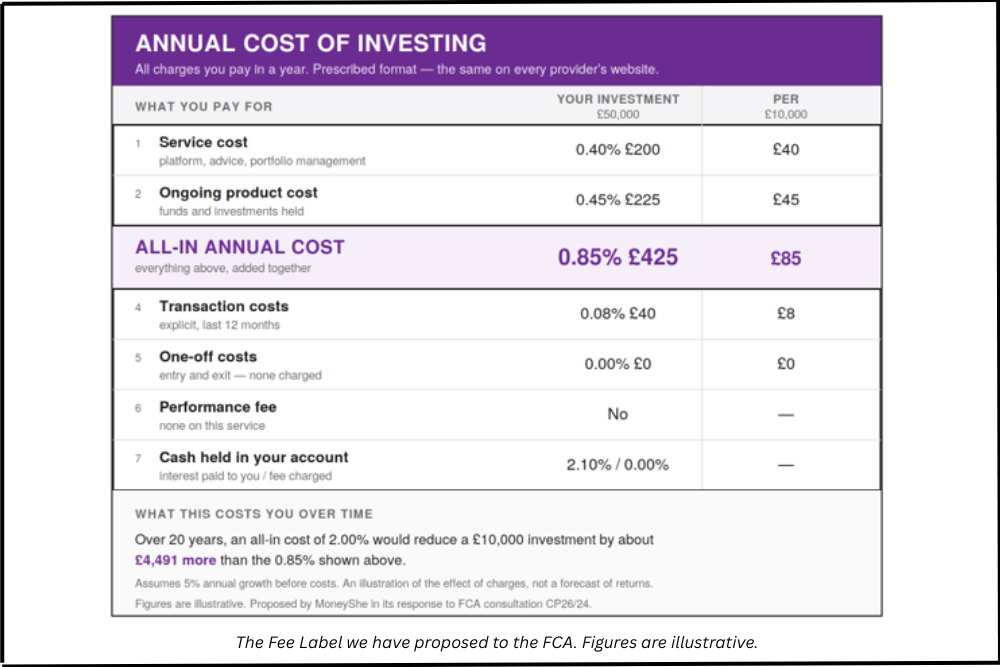
The regulator, the FCA, is on the case. On 2 July, the Financial Conduct Authority (FCA) published new proposals to make the cost of investing much clearer. From 2027, firms will have to show you all the costs of investing: the product charge, the platform or service fee, and any trading costs, all added up into a total percentage number pre-purchase, and for clients post-purchase shown in both pounds and as a percentage, and worked out for the amount you’re actually investing.
They’re also cracking down on something called “double-dipping” on cash. This is where a platform quietly keeps some of the interest earned on the cash sitting in your account and charges you a fee on top. Under the new rules, firms will have to publish the interest rates they pay on your cash and clearly disclose any fees on it.
This is real progress, and MoneyShe welcomes it. Fees matter enormously, because they compound: a difference of even one percent a year, charged quietly over decades, can quietly eat a very large share of your final pot. Knowing what you pay is a foundation of everything.
Now, the catch worth understanding
The FCA has decided not to make every firm present its costs in the same format. The thinking is to give companies “flexibility” to show their fees in their own way, so they can be clearer and more engaging. And in fairness, nobody misses those dense, jargon-filled documents almost no one ever reads — the FCA found that only 6 in every 100 of them were written in plain English.
But here’s the problem: comparison.
If every company shows its fees in a different way or in a different place, it becomes very hard to compare two options side by side and see which is genuinely better value. And this really matters — nearly a third of people who invest through a platform without an adviser say they don’t actually know how much they’re being charged. Flexibility is welcome, but on its own it won’t fix that.
What we think would fix it: a label akin to a food label
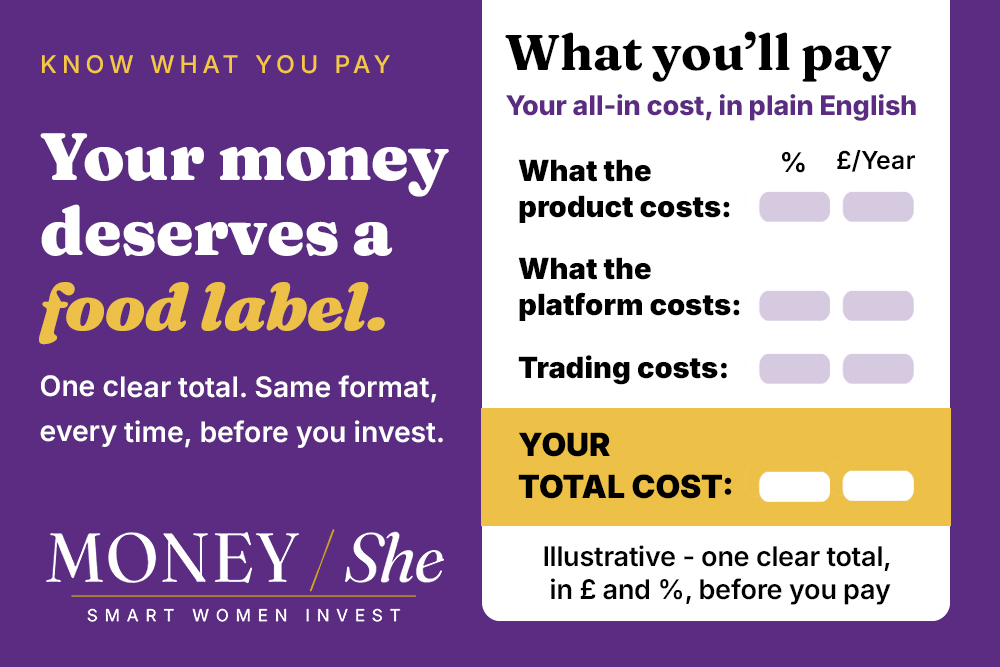
A simple, standardised fees label: your all-in cost, in pounds and as a percentage (for example on a £20,000 ISA), shown in the same format and the same place, before you buy. Not a forty-page document — a clear label. So that you, whatever your experience and however new to investing, can compare one option against another in seconds and choose with confidence.
Some of the industry doesn’t love this idea. They argue a fixed format limits innovation. But a nutrition label doesn’t stop a company making wonderful food — it just tells you honestly what’s in it. Your investments should work exactly the same way.
This is why MoneyShe exists
This isn’t a new argument for us. MoneyShe grew out of decades of campaigning for precisely this. Through the True & Fair Campaign, founded in 2012, Gina and Alan Miller fought for a “True & Fair Label” for investments, modelled directly on food labels, so that ordinary investors could finally see the true cost of what they were being sold. Their work helped change the law across the UK and Europe in 2014.
The principle behind it is simple, and Gina has said it for years: “You can’t have a fair market if you don’t know the price.” — Gina Miller, Founder
What you can do right now
You don’t have to wait until 2027 to protect yourself. Whenever you’re choosing where to invest:
- Ask for the total, all-in cost. The product charge, the platform fee, and any trading costs combined — and ask for it in both pounds and a percentage. If a firm can’t give you one clear number, that tells you something.
- Check how your cash is treated: Does your platform pay you interest on the cash in your account? Does it also charge a fee on that cash? You’re entitled to know both.
- Never feel embarrassed to ask. “What am I paying in total, in pounds?” It is your money, and a straight answer is the least you should expect and deserve.
The FCA’s consultation is open until 21 August 2026, and our Founder, Gina Miller, will be responding. Arguing, as we always have, for a clear, standard fees label that works for everyone, not just the experts.
Because understanding what you pay isn’t a nice-to-have. It’s the foundation of investing with confidence.
The MoneyShe Team
This article is for general information and does not constitute personal financial advice. MoneyShe is a trading name of SCM Private LLP. Authorised and regulated by the Financial Conduct Authority (No. 497525).