

The FCA’s consultation on fee disclosure, CP26/24, closed on 21 August. It covered what firms must tell you about charges, what happens to the interest on your cash, and how disclosure should work now that investors increasingly use AI to research their options. Submissions are rarely made on behalf of women, so MoneyShe made one. None of what we asked for is difficult. All of it would put a number in front of you that is currently difficult to find, industry-wide.
Start with something that gets reported as a failing and is nothing of the kind. The numbers.
Women hold more of their money in cash than men do – around 29% of assets against 25%. More than a million more of us hold a Cash ISA. When we pay into an ISA, only 29% of women direct it into stocks and shares, against 41% of men.
The usual explanation is that we are cautious. Nervous. In need of more confidence.
Try a different thought process. We are more likely to take career breaks, more likely to work part-time, more likely to be the person who stops when a parent falls ill. We earn less across a lifetime and live longer at the end of it. Structural, societal issues not of our making.
“Caution is a rational response to a thinner cushion. It is not a character flaw. But it should not carry a hidden charge.”
So we made three asks of the FCA. Here is each one, and what it would mean for you.
One: put the full price in one box
New rules will require firms to show what you pay in pounds rather than as percentages. What they will not do is make everyone show it the same way, in the same place – so you still cannot put two providers side by side, and compare and see which is cheaper.
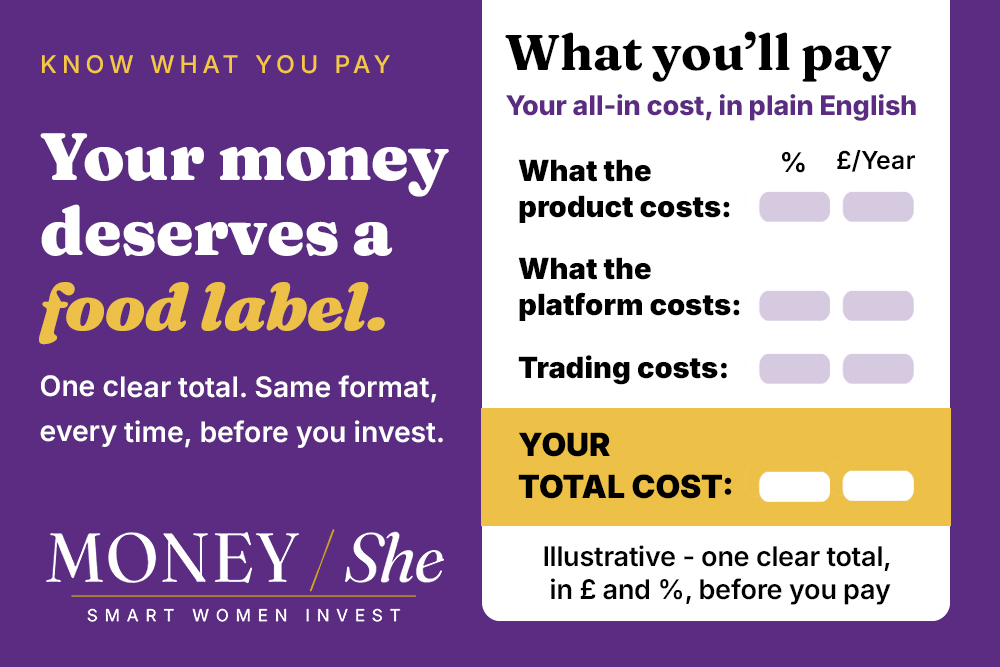
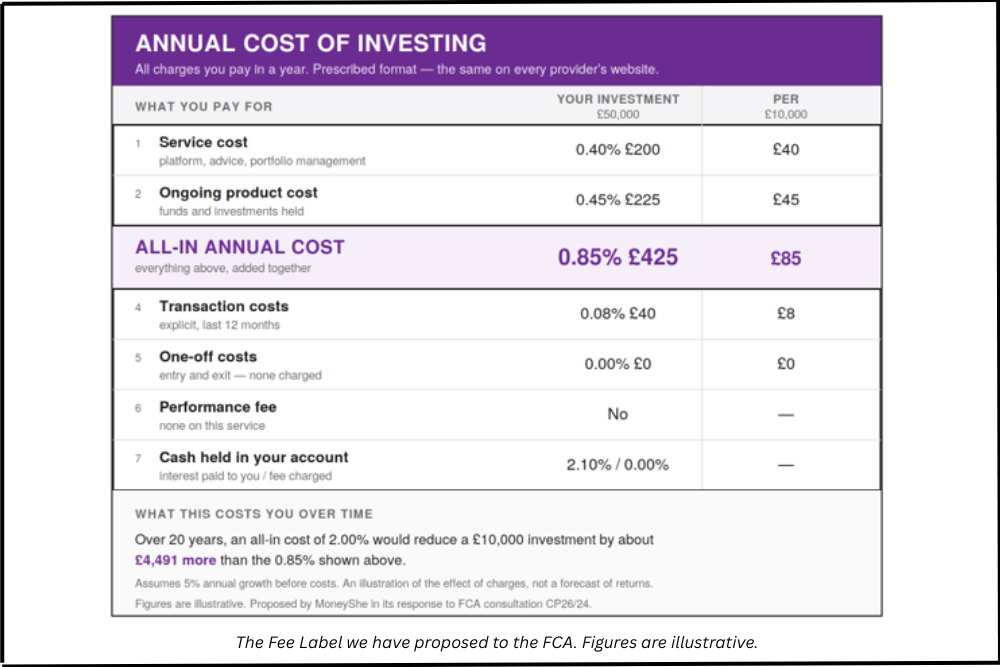
We asked for a Fee Label, like a food nutrition label. One box, seven lines, the same on every website, before you commit. The way a nutrition label works: it does not dictate the recipe; it just tells you what is inside, identically every time. It is absurd that you can see every ingredient on a chocolate bar, but not every cost of your pension or investments.
What it is worth to you
The ability to compare in thirty seconds what currently takes an afternoon – and the ability to notice when you are paying more than you need to. 1.15 percentage points is the whole distance between a competitively priced portfolio and an averagely priced one – and over 20 years it costs you almost exactly a fifth of everything you would otherwise have ended up with. On £250,000, that is more than £112,000. That is the same money, the same market, BUT a different price.
Two: stop leaving pensions out
At paragraph 4.11 of its consultation, the FCA proposes to change nothing for pensions. No requirement to tell you what yours actually cost you.
Charges do their greatest damage over the longest periods, and women arrive at retirement with fewer contributing years for growth to make up the difference. The gender pension gap has widened to £113,000. The one product where women are most exposed to cost is the one being left out by the FCA.
What it is worth to you
A figure, in pounds, for what your pension cost you last year – which at the moment you almost certainly cannot obtain. We asked the FCA either to include pensions or to commit to a review by a specified date. Not an intention. A date.
Three: say what happens to your cash
This is the one almost nobody knows about.
Cash sitting in your ISA or investment account earns interest. Bank Rate is 3.75%. What providers pay ranges from under 1% to around 2.8%. The rest stays with them – on the lower tiers, close to three-quarters of it.
On £20,000 held in cash for a year, that is the difference between receiving £200 and receiving £560.
And because nobody takes money out of your account – they simply do not pass all of it on to you – it appears on no fee card anywhere. If a provider announced a charge for holding cash, there would be an outcry. Instead, they keep most of the interest and call themselves ‘low-cost’.
What it is worth to you
We have asked for cash terms on the Fee Label. For firms to disclose how much interest they keep, rather than only the rate they pay, and to publish a 12-month rate history for checking. Together, those would make visible the one cost that currently is not.
It is not a confidence gap. It is a clarity gap.
Of more than 80 UK industry reports on women and investing published over five years, 57% described women’s confidence in negative and often patronising terms. One in five women said reading that put them off investing altogether; a further 17% said it left them less motivated.
Five years of an industry measuring women’s confidence, and almost none of it measuring its own clarity.
You cannot be confident about a price you cannot see. That is not a failure of nerve, and it does not sit on your shoulders.
If you are not a MoneyShe client, here are five tips in ten minutes to help you know your true costs:
- Add up what your provider charged you over the last year, in pounds. Not the percentage – the amount.
- Add the ongoing charge of each fund you hold. It is on every factsheet, usually called the OCF.
- Find the interest rate paid on your cash. Try Rates and Charges, or the FAQs. It is almost never on the main screen.
- Multiply your cash balance by that rate, and hold the answer against 3.75%.
- Ask them directly: what rate am I paid, do you also charge a fee on this cash, and how much of the interest do you keep?
However long it takes is worth noting. A number that takes half an hour to find was not designed to be found.
Who we are
MoneyShe was founded by Gina Miller to close the gender investment and pension gap – through education, through campaigning, and since 2024 through portfolios for women who want their money managed by balancing risk and returns, and providing 100% transparency on fees and holdings, stated plainly.
We should be straight about our interest. A rule requiring every firm to publish an all-in price in a standard format would cost us almost nothing, because we already publish ours in full and in one place before anyone invests.
The firms for whom it would be expensive are the ones whose prices are hardest to find today. That is not a coincidence – it is the argument.
Read our FCA submission press release here
AND ONE THING YOU CAN DO TO HELP US HELP YOU
We are currently surveying women across the UK about trust, what would genuinely make investing feel worth doing, and what people actually know about their charges. It takes four minutes.
We will publish the findings in September and send them to the FCA. The more women take part, the harder they are to ignore.
Please complete and share with any women you know – it only takes minutes, but the data will be meaningful: Take the MoneyShe Women & Money Survey
Capital at risk. The value of investments can go down as well as up and you may get back less than you invest. Past performance is not a guide to future returns. Illustrations of the effect of charges assume 5% annual growth before costs and are not forecasts. The quoted interest rates are as published by providers in August 2026 and are subject to change. This article is general information and does not constitute personal financial advice or a recommendation. If you are unsure what is suitable for you, seek regulated advice. MoneyShe is a trading name of SCM Private LLP, authorised and regulated by the Financial Conduct Authority (No. 497525).