


Two things are true at the same time. Women are, on average, careful and disciplined savers. And women, on average, retire with a fraction of what men do. The distance between those two facts is the story of this article — and it is not your fault.
If you have ever looked at your pension and felt dread, you are not alone, and importantly, you are not failing. Across the UK, women reach retirement with roughly a third less pension than men — and at the age when it matters most, the gap is even far wider. It is one of the largest, most stubborn inequalities in British financial life, and almost nobody is talking to women plainly about how to close it.
So let’s do that here. No jargon, no shame, no pink-ribbon nonsense. Just the numbers, why they look the way they do, and a plan you can follow.
How big is the gender pension gap?
The headline figure most often quoted is a gender pension gap of around 33% — men retiring with about a third more than women. The House of Commons Library puts it near 32.9%. That alone should stop us in our tracks.
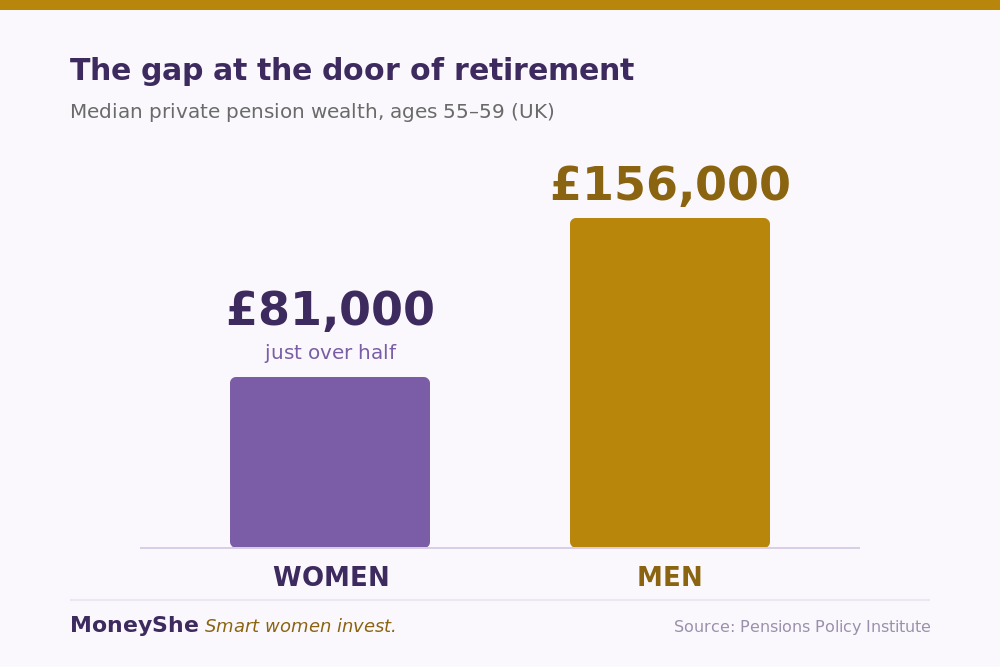
But the averages hide the worst of it. By the age when people have done most of their saving — their late fifties — the picture is starker. The Pensions Policy Institute finds that women aged 55–59 have a median private pension wealth of about £81,000, compared with roughly £156,000 for men the same age. That’s women holding a little over half of what men have, right as they enter retirement.
And it gets worse before it gets better. Include the many women who reach later life with no private pension at all, and the gap widens to as much as 62%. Women make up 57% of pensioners living in poverty. On the current trajectory, one analysis suggests the gap won’t fully close until around 2114 — nearly 90 years away.
The pension system was built around a career women are never guaranteed: uninterrupted, full-time and well-paid. Break any one of those, and the maths breaks with it.
But I’ve been paying into my pension. Surely I’m fine?
This is the sentence I hear often: “I’m in the workplace scheme; I pay in every month — surely I’ll be ok?” It is a completely reasonable thing to think. It’s also where the system lets women down.
Auto-enrolment was genuinely good and got millions saving. But it was designed around a full-time, unbroken, steadily rising salary. Women’s working lives are more likely to include the very things that scheme was never built for:
Career breaks to have children. Years of part-time work while caring — for children first, often for parents later. Lower average pay, so a smaller slice of every pay packet goes in. Time out that stops contributions altogether, right in the years when compounding does its heaviest lifting. The Institute for Fiscal Studies and others find that these gendered working patterns — not any lack of effort, ability or confidence — are the single biggest driver of the gender pension gap.
And the type of pension matters. In defined-contribution schemes — the kind most people now have — the gap at ages 55–59 has been measured as high as 75%, far worse than in old-style final-salary schemes, because DC pots simply reflect whatever went in, whenever it went in.
In other words: hesitation and shortfalls here are not a personal failing. They are a design failing. It’s not you. It’s the system.
Why closing it matters more than the number suggests
A pension gap has real, devastating consequences. It is the difference between choosing when you stop working and being forced to keep going. Between staying in your home and not. Between independence and dependence — on a partner, on a family member, on a state pension that was never meant to carry the whole load. Even the choice between heating and eating.
I built MoneyShe because I know, personally, that financial independence is not a luxury. It is safety. Every woman deserves to know her money is hers, that she can build a cushion in case of emergencies, that she understands it, and that no one else holds the keys to it.
A plan to close your own pension gap
The numbers may appear stark, but the plan really isn’t. You don’t need to become a finance expert; you just need a handful of deliberate, common-sense steps.
- Find all of it. Track down every pension you’ve ever had, including old workplace pots from jobs you’ve long left. The government’s free Pension Tracing Service can help. You can’t fix what you can’t see.
- Don’t leave free money behind. If your employer matches contributions, pay in at least enough to get the full match. It is, quite literally, a pay rise you’re entitled to.
- Protect the years you step back. If you take a career break, keep contributions going where you can — even small amounts compound. A working partner should cover your pension contributions while you’re out of work; it’s one of the most powerful, least-used tools.
- Claim your credits. If you’re receiving Child Benefit, make sure you’re getting the National Insurance credits that protect your State Pension. Check your State Pension forecast on gov.uk — it takes two minutes.
- Use the tax relief. Pensions and Stocks & Shares ISAs come with real tax advantages; a SIPP tops up basic-rate contributions with 20% relief before you’ve done anything else.
- Make sure it’s invested — not sitting in cash. Money left in cash quietly loses value to inflation — it’s like a slow puncture and leaves you with less buying power. Investing, over the long term, is how you actually grow it.
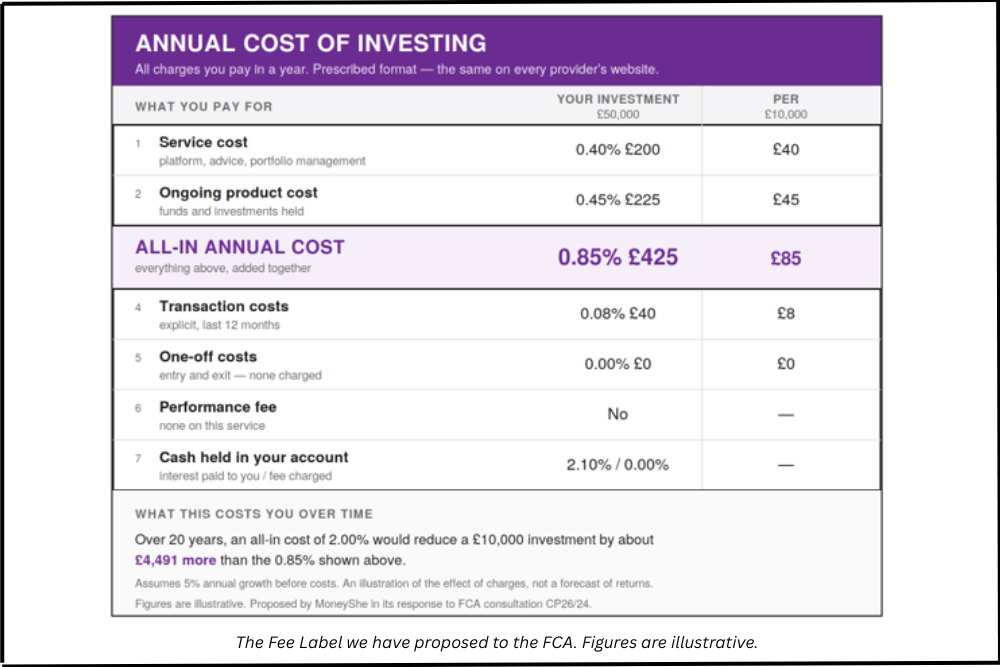
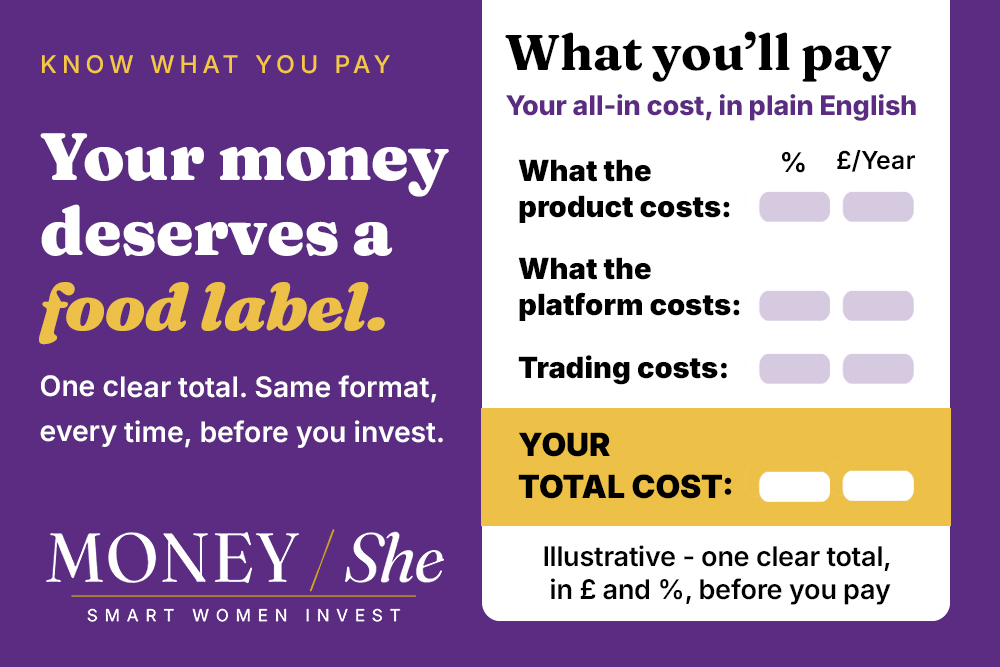
- Know exactly what you’re paying. Fees compound too — but against you. Insist on one clear, all-in cost you can read at a glance, and understand fully. That’s the whole idea behind our “nothing to hide” fee.
- Get a plan that fits you. You don’t have to guess. Our free Investment Matchmaker finds your risk profile and the portfolios that suit your life stage in a few minutes.
I know that reading all of this can feel defeating. Please don’t. The women who invest tend to do it well — they trade less, panic less and stay the course. The barrier was never your ability. It was information and permission you were waiting for and never needed.
Start closing your gap today. MoneyShe builds genuinely diversified, low-cost, transparent portfolios for women — with one all-in fee and a team that invests alongside you. No jargon, no judgement, no hard sell.
Common questions
What is the gender pension gap?
The gender pension gap is the difference between the average private pension wealth of men and women. In the UK it stands at roughly a third (about 33%), meaning women reach retirement with around a third less than men — and considerably more than that at peak saving ages.
Why do women retire with less than men?
Mainly because of gendered working patterns the pension system was never built for: career breaks for childcare and caring, more part-time work, and lower average pay. These interrupt contributions during the years when compounding matters most. It’s a structural problem, not a personal failing.
How much less do women retire with in the UK?
Around a third less on average. By ages 55–59, women hold median private pension wealth of roughly £81,000 versus about £156,000 for men — just over half. Including those with no pension at all, the gap can reach around 62%.
How can women close the pension gap?
Trace every old pension, claim your full employer match, keep contributing through career breaks (a partner can pay into your pension), protect your State Pension with National Insurance credits, use tax-efficient wrappers like a SIPP or ISA, make sure your money is invested rather than in cash, and keep costs low with one transparent all-in fee.
Smart women invest.
Sources include the Pensions Policy Institute, the Institute for Fiscal Studies, the House of Commons Library and the Great British Retirement Survey. Figures were correct at the time of writing and may change; please refer to the original sources for the latest data.
This article is for information only and is not personal advice or a recommendation. We think you should always know when the people offering you information also offer you a product — MoneyShe does. If you’re unsure whether investing is right for you, speak to an independent financial adviser. Capital at risk: investments can fall as well as rise, and you may get back less than you invest. Tax treatment depends on your individual circumstances and may change. MoneyShe is a trading name of SCM Private LLP, authorised and regulated by the Financial Conduct Authority (no. 497525).