

Two things can be true at the same time. The state pension is one of the best things this country has ever built for later life. But on its own, it will not give you the retirement you’re hoping for.
On 29 September, Prime Minister Andy Burnham announced the biggest change to the triple lock since it was introduced, with the savings earmarked towards a new National Care Service.
Cue the headlines, the worry and a great deal of heat. So, let’s take a breath, look at what is actually changing, and then talk about the part of your retirement that no government can redesign for you.
Who actually pays your state pension?
Before we look at what is changing, it helps to know who actually pays your pension. I’m often asked why today’s National Insurance contributions pay for today’s pensioners. The answer, not widely understood, is that the UK State Pension operates largely on a pay-as-you-go basis. National Insurance and other government revenues collected fund today’s pension payments, rather than being placed in an individual investment pot for the contributor’s own retirement.
The basic logic is a system that works as an intergenerational exchange:
- Today’s workers and employers contribute through National Insurance and taxation.
- That money helps pay today’s retirees.
- In return, today’s workers acquire an entitlement – subject to future legislation – to receive a state pension when they retire.
- Their pensions will then be paid largely by the workers and taxpayers of that future time.
So, our pension system is less like a personal savings deposit and more like a social insurance payment that earns a future promise.
Why was it designed this way?
Pay-as-you-go systems allowed governments to start paying pensions immediately, without waiting decades for a large investment fund to build up. They worked well when populations were younger, and the number of workers was rising relative to the number of pensioners.
There is also a practical economic reason: even a fully funded pension cannot literally store future goods and services. Retired people ultimately depend on the economy’s future workers to produce food, housing, healthcare and other goods. A pension fund can accumulate financial assets, but those assets are claims on future production.
Today’s reality
The arrangement becomes harder to sustain when there are:
- fewer workers per pensioner;
- longer retirements;
- slower growth in wages and employment; and
- relatively low birth rates.
A pay-as-you-go system’s implicit return is closely linked to workforce growth and average earnings.
When the number of pensioners grows faster than the number of workers – deaths are projected to outnumber births in the UK from this year, the fertility rate in England and Wales is at a record low of 1.41, and AI may reshape the jobs market in ways no one can yet predict – governments have to respond through higher revenues, lower benefits, later retirement, greater productivity or other reforms.
In the UK, the number of people of pensionable age for every 1,000 people of working age is projected to rise from around 280 in 2024 to 310 in 2034, and 329 by 2049. The pensionable-age population is projected to increase by 1.8 million between 2024 and 2034 (ONS, National Population Projections, April 2026).
The key point is that your National Insurance contributions are not normally being saved for you personally. They help finance the current generation of pensioners while giving you a politically and legally conditional claim on the future system.
Pension sustainability is fundamentally a question of demographics, economic growth and intergenerational fairness – not simply whether enough money has been “put aside”.
So what is the triple lock – and why is it changing?
The triple lock is the rule that decides how much the state pension rises each April. Since 2011, the flat-rate state pension has gone up by whichever is highest of:
- average earnings growth;
- CPI (Consumer Price Index) inflation; or
- 2.5%.
It promises that your pension will never lose value to rising prices and will keep pace with the wages of people still in work.
A short history of the triple lock
For three decades from 1980, the basic state pension rose only in line with prices. As a result, year after year it slipped further behind wages, and pensioners fell further behind everyone else.
In 2010, the coalition government used its first Budget to put that right. The triple lock was announced that summer and first applied in April 2011. When the new state pension arrived in 2016, it was triple locked too.
Since then, it has been tested. In 2022, it was suspended for one year because the pandemic had pushed earnings growth to unrealistic levels. Pensions rose by inflation, at 3.1%, instead. Then came the cost-of-living shock, and the lock did exactly what it was designed to do:
| April rise | Increase | Driven by |
|---|---|---|
| 2022/23 | 3.1% | Inflation (triple lock suspended; “double lock” for one year) |
| 2023/24 | 10.1% | Inflation |
| 2024/25 | 8.5% | Earnings growth |
| 2025/26 | 4.1% | Earnings growth |
| 2026/27 | 4.8% | Earnings growth |
Today the full new state pension is £241.30 a week, about £12,550 a year.
But there is a catch, and the Institute for Fiscal Studies (IFS) has pointed it out for years. Because the pension takes the highest of three numbers every single year, it ratchets upwards: each spike becomes permanent.
The IFS estimates the triple lock has added £16 billion a year to state pension spending by 2026/27, compared with simply rising in line with earnings. That is a lot of money, and it is very hard to predict.
What changes from 2030?
From 2030–31, the state pension is due to rise each year by the highest of:
- CPI inflation;
- 2.5%; or
- whatever is needed to keep the pension in step with average earnings growth since the new rule began.
The difference is in number 3.
Under the old rule, every unusual year became a permanent upgrade. Under the new one, the pension still never falls behind prices and still rises by at least 2.5%, but once it has run ahead of wages, it waits for wages to catch up rather than racing on. So the proposed changes keep the core principles – a material rise every year, protection against rising prices, and pensioners sharing in the benefits as the economy grows – but remove the permanent ratchet effect. A welcome reform, but is it enough?
What will it save?
Politically, it is a brave move – few prime ministers have been willing to touch the triple lock. The government estimates it will save around £15 billion a year by 2039 – 40 (about £11 billion in today’s money). In the shorter term, the savings are much smaller: the IFS expects around £4 billion a year by 2034 – 35, and possibly nothing at all if wages grow strongly. Over the long run, it puts the savings between £4 billion and £20 billion a year. That is not enough to fully fund a National Care Service, but it is a step towards a more sustainable state pension.
There is a catch, though. The IFS’s point is subtle but important: stopping a future increase that was never paid for does not create new money to spend. Care reform will still need tax rises or cuts elsewhere.
Baroness Ros Altmann, the former pensions minister, says the numbers “do not stack up”. She wants a proper cross-party review, especially with the Pensions Commission and the social care review both due to report next year, in 2027.
You can take whichever side of that debate you like. For anyone planning their own retirement, the headline is simpler: the state pension is set to become steadier and more predictable, but it will still be modest.
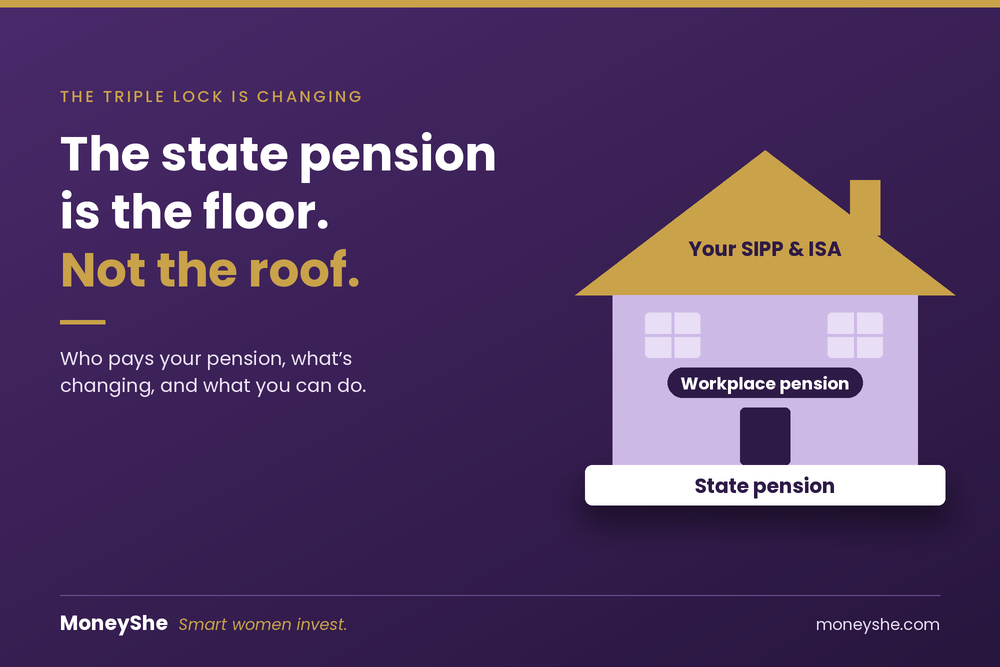
Think of your retirement as a house
I find it helps to picture retirement as a home you are building for your older self.
The state pension is the floor. It is solid, protected against rising prices (inflation), and lasts for life, which is exactly why reforms like this matter so much to so many.
But a floor is not a home. The Retirement Living Standards research for Pensions UK puts a moderate retirement for one person, outside London, at £31,700 a year, and a comfortable one at £43,900. Even after this April’s rise, the full state pension covers only around 40% of a moderate retirement and less than 30% of a comfortable one.
Your workplace pension builds the walls. Your employer pays in alongside you, you get tax relief, and decades of contributions shape your retirement. Auto-enrolment sets a minimum of 8%, but Pensions UK suggests 12% or more gives you a far better chance of the retirement you expect.
Your own savings are the roof. A SIPP, a Stocks & Shares ISA, the money you invest for yourself. The roof is what keeps the weather out: a longer life than you planned, inflation, illness, care costs, or a divorce you never saw coming.
“The state pension is the floor of your retirement. It was never meant to be the roof.”
Here’s the uncomfortable truth about politics and pensions. The government owns the floor. It can change how it maintains the floor, and the government has just announced that it will. The walls and the roof are yours.
“But I’ll get the full state pension. Surely that’s fine?”
Perhaps. But the full new state pension needs 35 qualifying years of National Insurance, and you get nothing at all with fewer than 10 years. Years spent raising children, caring for parents or working part-time on low pay can leave gaps, and those gaps fall disproportionately on women.
Even when the floor is the same size for men and women, the walls and roof are not. The Pensions Policy Institute finds that women aged 55–59 have a median private pension wealth of about £81,000, compared with roughly £156,000 for men. That is the gender pension gap in one line.
Women aren’t bad at saving. A system built around an unbroken, full-time career simply builds smaller houses for women.
Your five-step plan
Politics is noisy and can be confusing, but the plan is quieter and much more straightforward; you can start it this week.
- Check your floor. Get your state pension forecast at gov.uk/check-state-pension. It shows your qualifying years and any gaps.
- Fill the cracks. If you have claimed Child Benefit for a child under 12, you should have received National Insurance credits. Registering still counts even if you opt out of the payments. Carers can claim credits too. If you still have gaps, voluntary contributions can be good value, but check with the Future Pension Centre or MoneyHelper before you pay.
- Inspect your walls. Find out what you and your employer pay in. Could you move from 8% towards 12%? Will your employer match more? Track down old pots with the government’s free Pension Tracing Service.
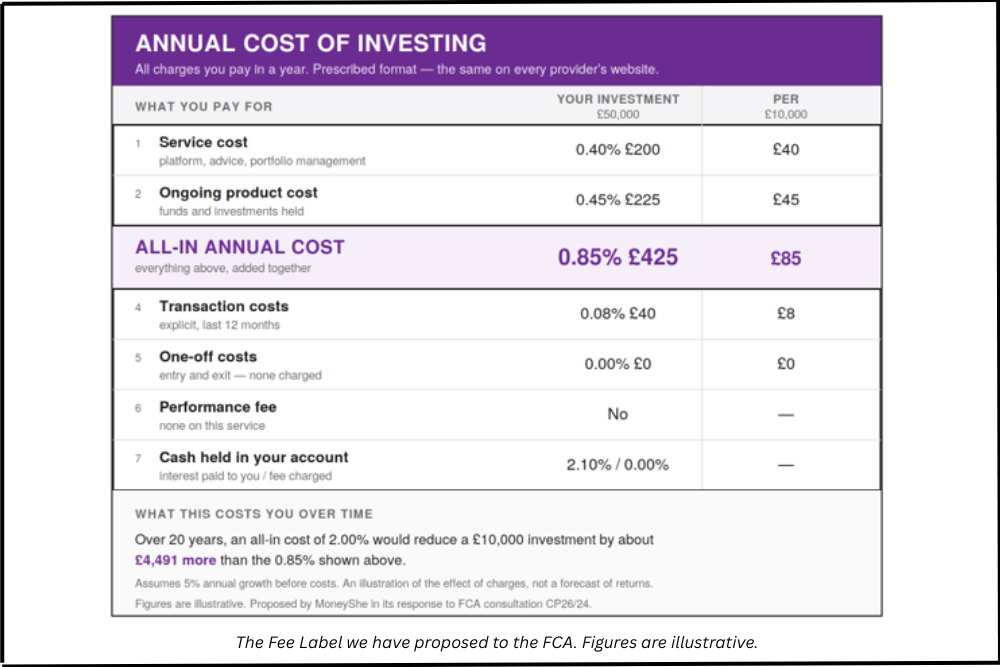
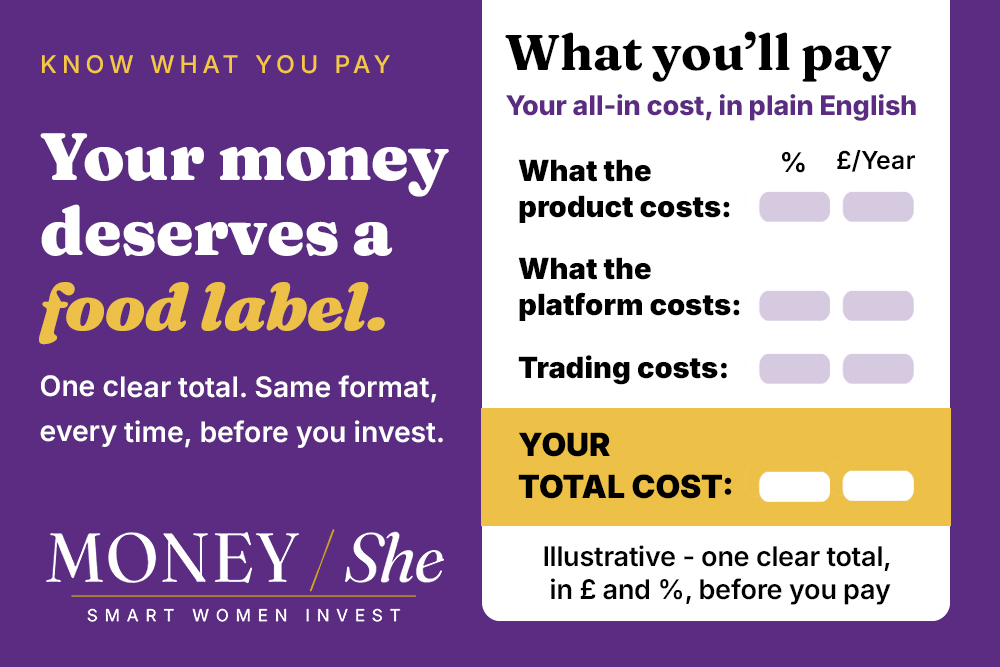
- Put on a roof. Build long-term savings you control, in a SIPP or a Stocks & Shares ISA. Watch the fees, because they compound just as surely as returns do. Our all-in fee is 0.85% against an industry average of around 2%. You can see the difference over time with our fee calculator.
- Draw the house you want. Pick a living standard (minimum, moderate or comfortable), take off your state pension forecast, and you have the gap your walls and roof need to fill. If you would like to talk it through, book a free call – we are always happy to help.
Deeds, not words
It is tempting to read the headlines and feel that retirement is something done to you, by politicians, in conference halls. Please don’t. The floor is being re-laid, and it will still be there, steadier than before. Everything above it is in your hands, and it is never too late, or too early, to start building.
Gina Miller, Founder, MoneyShe
Common questions
What is the triple lock?
The triple lock is the rule for uprating the state pension. Since 2011, the flat-rate state pension has risen each April by the highest of average earnings growth, CPI inflation or 2.5%.
Is the UK state pension funded or pay-as-you-go?
Largely pay-as-you-go. National Insurance and other taxes collected from today’s workers pay today’s pensions. Your contributions are not saved in a personal pot; they earn you an entitlement, subject to future legislation, to a state pension when you retire.
How will the new triple lock work from 2030?
From 2030–31, the state pension is due to rise by the highest of CPI inflation, 2.5%, or the amount needed to keep it in line with average earnings growth since the new rule began. It keeps the inflation and 2.5% protections but removes the permanent “ratchet” of the old rule.
How much will the triple lock reform save?
The government estimates around £15 billion a year by 2039–40, about £11 billion in today’s money. The IFS expects around £4 billion a year by 2034–35 and says the long-run saving could be anywhere between £4 billion and £20 billion a year.
Is the state pension enough to retire on?
For most people, no. The full new state pension is £241.30 a week (about £12,550 a year) in 2026/27. The Retirement Living Standards put a moderate retirement for one person at £31,700 a year, so the state pension covers around 40% of it. Workplace pensions and personal savings such as a SIPP or ISA need to fill the rest.
This article is for information only and is not personal financial advice. If you are unsure what is right for you, please seek independent advice. MoneyShe offers a SIPP and a Stocks & Shares ISA. We think you should always know when the people offering you information also offer you a product. Capital at risk: investments can fall as well as rise, and you may get back less than you invest. Tax treatment depends on your individual circumstances and may change. You cannot normally access a pension until age 55 (57 from April 2028). The triple lock changes described are government proposals due to take effect from 2030–31 and may change before they become law. MoneyShe is a trading name of SCM Private LLP, authorised and regulated by the Financial Conduct Authority (no. 497525).